
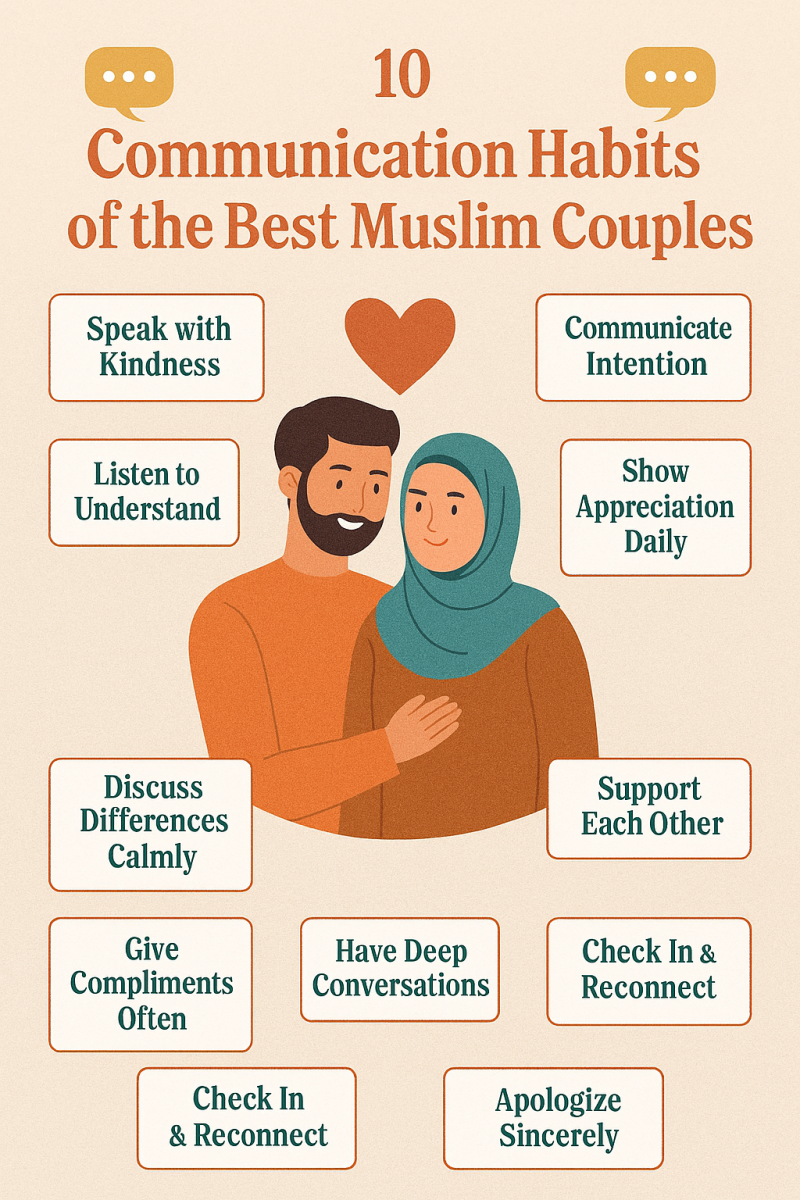
10 Communication Habits of the Best Muslim Couples
Strong Muslim marriages aren’t built on grand romantic gestures — they’re built on daily, intentional communication rooted in the Qur’an and Sunnah. The happiest and most resilient Muslim couples consistently practice these 10 communication habits.
1. They Begin and End Conversations with Salams and Duʿā’
The Prophet ﷺ said: “When any one of you meets his brother, let him say salam.” (Muslim)
They end with “JazakAllah khayr” or a short duʿā’ for each other. This simple habit turns every conversation into ʿibādah.
2. They Speak with “Qawlan Sadīda” (Straight, Truthful, Beautiful Speech)
“O you who have believed, fear Allah and speak words of appropriate justice (qawlan sadīda).”
3. They Practice Active Listening (Samʿan wa Tāʿah to Each Other)
Great Muslim husbands and wives put down their phones, face each other, and listen to understand — not just to reply.
4. They Say “I Feel…” Instead of “You Always…”
They say: “I feel overwhelmed when the house is messy after a long day.”
This Sunnah-inspired approach prevents blame and opens the door to solutions.
5. They Use the 24-Hour Rule for Anger
Wise couples agree: no serious discussion when emotions are high. They wait (usually no longer than 24 hours) until both are calm.
6. They Schedule Weekly “Heart-to-Heart” Check-Ins
- What made you smile this week?
- Where did you feel stressed or hurt?
- How can I support you better next week?
- One thing I’m grateful for about you
“I love you for the sake of Allah” or “May Allah love you as much as I do”
This reminder keeps romance spiritual and eternal. 9. They Make Duʿā’ for Each Other in Every Salah Strong Muslim couples never miss praying for their spouse in sujood. Many keep a shared duʿā’ list in their prayer area with specific requests for each other. 10. They End Every Argument with Forgiveness and a Hug
- “I forgive you for the sake of Allah”
- “May Allah forgive us both”
- A long hug (scientifically proven to lower cortisol and increase oxytocin)
The best couples never start a serious talk without saying “Assalamu Alaikum” and making duʿā’ for barakah in their words.
Allah commands in Surah Al-Ahzab (33:70):
Top Muslim couples avoid sarcasm, mockery, and harshness. They choose words that are honest yet gentle — even during disagreements.
The Prophet ﷺ was the best listener. He would turn his full body toward the speaker and maintain eye contact.
Instead of: “You never help around the house!”
Following the hadith: “If one of you is angry, let him sit down… if anger does not go away, let him lie down.” (Abu Dawud)
Every Thursday or Friday night, many strong couples have a 20–30 minute talk with this simple structure:
This habit prevents small issues from becoming mountains.
The Prophet ﷺ praised Khadijah (RA) and Aisha (RA) in public, but corrected gently in private.
“Loving for Allah” (hubb fillah) is the strongest bond.
The most powerful communication isn’t verbal — it’s duʿā’.
Even if they don’t fully agree, they end with:
The Prophet ﷺ said: “Shall I not tell you of something that is better than fasting, prayer, and charity? Reconciling between people.” (Tirmidhi)
The best Muslim couples understand that communication isn’t just about talking — it’s about building a home where Allah’s peace (sakīnah), mercy (rahma), and love (mawadda) live (Qur’an 30:21).
Start practicing even one of these habits today, and watch your marriage transform — in this world and in the scale of your good deeds in the next.